Tuesday, April 23, 2013

After-Hours Trading:Understanding the Risks

The New York Stock Exchange and the Nasdaq Stock Market—the highest volume market centers in the U.S. today—have traditionally been open for business from 9:30 a.m. to 4:00 p.m. Eastern Time. Although trading outside that window—or "after-hours" trading—has occurred for some time, it used to be limited mostly to high net worth investors and institutional investors.

But that changed by the end of the last century. Some smaller exchanges now offer extended hours. And, with the rise of Electronic Communications Networks, or ECNs, everyday individual investors can gain access to the after-hours markets. Before you decide to trade after-hours, you need to educate yourself about the differences between regular and extended trading hours, especially the risks. You should consult your broker and read any disclosure documents on this option. Check your broker's website for available information on trading after-hours. As with trading during regular hours, the services offered by brokers during extended hours vary. You should therefore shop around to find the firm that best suits your trading needs.

While after-hours trading presents investing opportunities, there are also the following risks for those who want to participate:

  • Inability to See or Act Upon Quotes. Some firms only allow investors to view quotes from the one trading system the firm uses for after-hours trading. Check with your broker to see whether your firm's system will permit you to access other quotes on other ECNs. But remember that just because you can get quotes on another ECN does not necessary mean you will be able to trade based on those quotes. You need to ask your firm if it will route your order for execution to the other ECN. If you are limited to the quotes within one system, you may not be able to complete a trade, even with a willing investor, at a different trading system.
  • Lack of Liquidity. Liquidity refers to your ability to convert stock into cash. That ability depends on the existence of buyers and sellers and how easy it is to complete a trade. During regular trading hours, buyers and sellers of most stocks can trade readily with one another. During after-hours, there may be less trading volume for some stocks, making it more difficult to execute some of your trades. Some stocks may not trade at all during extended hours.
  • Larger Quote Spreads. Less trading activity could also mean wider spreads between the bid and ask prices. As a result, you may find it more difficult to get your order executed or to get as favorable a price as you could have during regular market hours.
  • Price Volatility. For stocks with limited trading activity, you may find greater price fluctuations than you would have seen during regular trading hours. News stories announced after-hours may have greater impacts on stock prices.
  • Uncertain Prices. The prices of some stocks traded during the after-hours session may not reflect the prices of those stocks during regular hours, either at the end of the regular trading session or upon the opening of regular trading the next business day.
  • Bias Toward Limit Orders. Many electronic trading systems currently accept only limit orders, where you must enter a price at which you would like your order executed. A limit order ensures you will not pay more than the price you entered or sell for less. If the market moves away from your price, your order will not be executed. Check with your broker to see whether orders not executed during the after-hours trading session will be cancelled or whether they will be automatically entered when regular trading hours begin. Similarly, find out if an order you placed during regular hours will carry over to after-hours trading.
  • Competition with Professional Traders. Many of the after-hours traders are professionals with large institutions, such as mutual funds, who may have access to more information than individual investors.
  • Computer Delays. As with online trading, you may encounter during after-hours delays or failures in getting your order executed, including orders to cancel or change your trades. For some after-hours trades, your order will be routed from your brokerage firm to an electronic trading system. If a computer problem exists at your firm, this may prevent or delay your order from reaching the system. If you encounter significant delays, you should call your broker to determine the extent of the problem and what you can to get your order executed.

For tips on how to invest wisely, visit the Investor Information section of our website. You can learn more about the impact of ECNs and after-hours trading on the securities markets by reading a special study that the staff of the SEC prepared in June 2000.

zzWhat is after-hours trading? Am I able to trade at this time?

After-hours trading (AHT) refers to the buying and selling of securities on major exchanges outside of specified regular trading hours. Both the New York Stock Exchange and the Nasdaq National Market operate from 9:30 a.m. to 4:00 p.m. EST. At one time limited to institutional investors and individual investors with high net worth, AHT is now an option for the average investor as well.

The emergence of electronic communication networks (ECNs) ushered in a new era in stock trading. An ECN is an interface that not only allows individual investors to interact electronically, but also lets large institutional investors interact anonymously, thereby hiding their actions.

The development of AHT offers investors the possibility of great gains, but you should also be aware of some of its inherent risks and dangers:
  • Less liquidity - There are far more buyers and sellers during regular hours. During AHT there may be less trading volume for your stock, and it may be harder to convert shares to cash.

  • Wide spreads – A lower volume in trading may result in a wide spread between bid and ask prices. Therefore, it may be hard for an individual to have his or her order executed at a favorable price.

  • Small fish – While individual investors now have the opportunity to trade in an after-hours market, the reality is that they must compete against large institutional investors that have access to more resources than the average individual investor.

  • Volatility – The AHT market is thinly traded in comparison to regular-hours trading. Therefore, you are more likely to experience severe price fluctuations in AHT than trading during regular hours.

We've covered the risks of AHT, but you should also be aware of the benefits. Having the ability to trade around the clock allows you to react quickly to breaking news stories or fresh information. Furthermore, although volatility is a risk associated with trading after hours, you may find some appealing prices during this time.

AHT has developed to the point where all interested investors, big or small, have an opportunity to do business outside of standard hours. Just remember that while there are benefits to participating in AHT, you should also be mindful of the risks.

Wednesday, April 17, 2013

Mecox Lane Offers Super Cheap Opportunity To Invest With Sina And eBay Partnership

One of the biggest losers of the US-listed Chinese Internet companies is Mecox Lane (MCOX). Its stock price fell from a 2010 IPO of $55 (reverse-split adjusted) to only $1.81 as of today. The main reasons for the fall were the large annual losses by the company in 2011-2012, and a general fear of fraud in Chinese companies.

But the facts about MCOX do not support a case for fraud. A recent joint venture with Giosis, which is 49% owned by eBay (EBAY) and run by Gmarket's founder, Young Bae Ku, offers a turnaround opportunity. And at its current price, MCOX is trading below the cash value on its balance sheet.

This opportunity has arisen because most institutional investors have liquidated their positions in MCOX. This selling pressure keeps the share price low. However, I think the bearers have been overreacting on Mecox Lane's case.

Company Background

Mecox Lane Ltd. was founded in 1996. It was backed by venture capital firm Warburg Pincus since its inception. Warburg Pincus sold its entire stake to Sequoia Capital in 2008 for $80 million. Mecox Lane went IPO on the NASDAQ on October 2010. The IPO price was $55 per American Depositary Share. (It was actually $11, but the ADR ratio has changed from 1:7 to 1:35 share ratio).

Mecox Lane operates M18.com which sold apparel and accessories. Its target internet audience is women. But MCOX also has other sales channels, including a call center and physical stores (both franchised stores and direct-operated stores). Gross profit margin from Internet sales is just 20%, which is the lowest of the three sales channels. The internet channel faces fierce competition in China. So the company decided to scale down its advertising expense which resulted to revenue decline in 2011 and 2012. This is the reason the company decided to pivot its platform and turn M18.com over to the good hands of Giosis.

In comparison, Mecox Lane has 2 proprietary brands, Euromoda and Rampage - licensed from ICONIX (ICON) which its physical stores focus on selling. Mecox Lane also has proprietary brands for healthcare (MaxiCare) and cosmetics products (La Celler) that are sold through the call center. These sales resulted in a higher gross margin for the store and call center channels than for the internet platform channel.

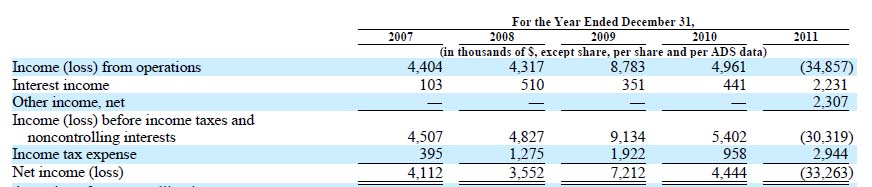
Since its IPO in December 2010, MCOX has suffered annual losses of over $55 million ($33 million 2011 and $22.4 million in 2012). The cause was the excessive competition in Chinese ecommerce space. The CEO of Mecox indicated in several conference calls that he was scaling down what he thought were absurdly high advertising fees. The reduced ad spending saved money, but resulted in a decline in revenue. The company also reduced spending by reduced the headcount. But the expenses still did not go down quickly enough. This resulted in operating losses despite declining operating costs. But prior to 2011, the company had been profitable. (See figure below which traced income back to 2007 from 20-F)

(click to enlarge)

Major Shareholders

Mecox Lane has very reputable majority shareholders, including SINA.com and Sequoia Fund. Most of the major shareholders hold shares at higher cost-basis than today's price. For example, SINA bought 18% of MCOX from Sequoia at $30 per ADS (ADR-ratio adjusted) in 2011. SINA puts $66 million in this investment which represents about 90% loss by current share price.

Most of Sequoia-backed Chinese IPOs (GAGA, CCSC and more) have suffered from low-valuation level since the IPO. But none of them have been a target of the short-seller. Sequoia is one of the biggest venture capital firms in the USA. Consequently, they might rush their portfolio companies to go IPO which force these companies to build business in unsustainable ways, such as excessive marketing expenses. But this aggressive stance does not make them frauds. Vipshop.com (VIPS) is a flash-sale website in China which made a debut last year in NASDAQ, and has made almost 300% gain from its IPO price at $6.5. Revenue of VIPS is growing rapidly but it is still operating at a loss. But it is still an impressive return in the stagnant market of Chinese companies on the US stock market.

My point is that internet business is one of easiest models to spot a fraud in. No one accuses VIPS or BIDU of fraud. So investors value these companies at fair price without a fraud's discount. MCOX, as the operator of M18.com, which is one of the leading ecommerce contender in China, deserves a better valuation from public market. But right now it is trading below cash per share, implying that investors are evaluating MCOX as if it were a fraudulent Chinese company.

Re-launching M18.com with partnership of Gmarket's founder and eBay

The recent JV announcement with Giosis to turn M18.com from an ecommerce website into an online market place platform also provided a vote-of-confidence and opportunity to turnaround this business. For this to happen, investors need to take some time and look at who Giosis is.

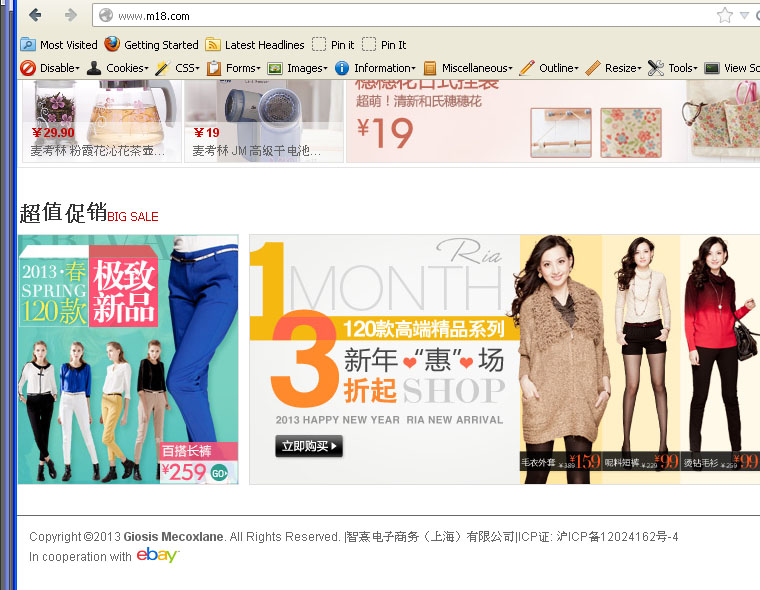
Giosis is the owner of Qoo10.com which is an online marketplace website serving major Asian countries. It is run by Mr.Young Bae Ku who is the founder of Gmarket.com, a South Korea internet company which was a Nasdaq-listed company that was sold to eBay for $1.2 billion in 2009. He later went to found Giosis to chase his ambition to make it big in Asia not just in South Korea. He moved his entire family to Shanghai to pursue an opportunity in China. That also showed the deep commitment he had in doing business in China. And 49% of Giosis also belongs to eBay. He then re-launched the new M18.com the 1st of January 2013. (Take a look at M18.com website now. It even has an eBay logo in the footer.)

(click to enlarge)

Giosis Mecoxlane is progressing rapidly. They have already launched a new M18.com app in both iOS and Android. I tried the iPhone version for about a week. They have new features within a couple of days. And last time I checked, they also had a lucky draw coupon which cost 1 RMB for each ticket to win an iPad Mini. The app is well-designed and easy to use and navigate.


The reason behind this JV is MCOX wants to exit the internet platform war and focus on making its own product lines. Also Giosis wants a strong brand, such as M18.com, to target female shoppers. M18.com will be the online marketplace for Women, not a general marketplace like Taobao or Qoo10.cn itself.

New Direction of Mecox Lane

The company has invested around $40 million in a new distribution center in Wujiang, which can handle 100,000 parcels a day. The CEO admits that the capacity is in excess of the company's current demand. However, the management is also planning to utilize the capacity as a 3rd party fulfillment service. The new M18.com as an online marketplace can act as a driver for this initiative.

Mecox Lane will be selling its own product line through a variety of internet channel, such as Tmall (Taobao) and Vipshop.com & Qoo10.cn (Giosis), as well as its new M18.com. Management expects this to save them on advertising expenses. The revenue from the internet platform is expected to decline in Q1 because the old M18.com also sells 3rd party products as 20% of total sale of their internet channel. But stopping 3rd party sales will improve the gross margin from internet sales. And free up some working capital.

The new JV (Giosis-Mecox lane) will be accounted for in equity method (MCOX invested $5 million and own 40% of the new JV). I expect the SG&A to decrease significantly because Mecox Lane can save by cuts to its huge online advertising cost. And the commission fee for using Tmall and the new M18.com will go to the selling expenses line. This is a much better business model, because commission fees for using other platforms is variable to sale volume.

Strong Balance Sheet and $10 million share buyback plan

The company announced $10 million share buyback plan on May 2012. Three quarters have passed since then, but it's only spent $572,000 in the buyback process. This is due to limitation on the buyback set by the US Securities and Exchange Commission. The company cannot buyback more than 25% of the 30-day average daily volume. Given that MCOX has sparsely traded, the company cannot buyback many of the shares. But the total outstanding number of ADS of MCOX is around 4 million (1:35 ADR share ratio) as of April 2012 (page 84, 2011 Form 20-F). So given the current price ($1.81) the buyback can still buyout all 4 million ADS outstanding.

At the end of December 2012, the company had $13 million in cash and $20.6 million in short-term investment which is in structured bank deposits equivalent to cash anyway. And $5 million to invest in the new JV is already booked as a prepaid expenses line. And there is no bank debt in both short-term and long-term. So, total equity is $89.9 million, while the current market capitalization is $21 million. It's trading at just 0.23x PB; and $21 million is even cheaper than total cash in hand.

CEO also owns a significant stake

Mr.Alfred Gu, the CEO, also own 18,364,525 ordinary shares which is about 5% of company. Additionally, he own 39 million options hence owning approximately 12.9 % of the company. An option has exercise price of $0.16/share which is equal to $5.6 per ADS. Major shareholders, such as SINA and China DongXiang (3818.hk), have a cost basis of $30 per ADS. Sequoia was able to cash out some share to SINA and DongXiang but still hold around 30% stake in MCOX. Another management staff has the option to purchase MCOX's ADS at $5.6. It's fortunate that public investors can gain entry at such significant discounts compared to major firms and insiders. Private investors should see from these actions, and the existing balance sheet, that MCOX is not the fraud they feared it was.

Going Forward

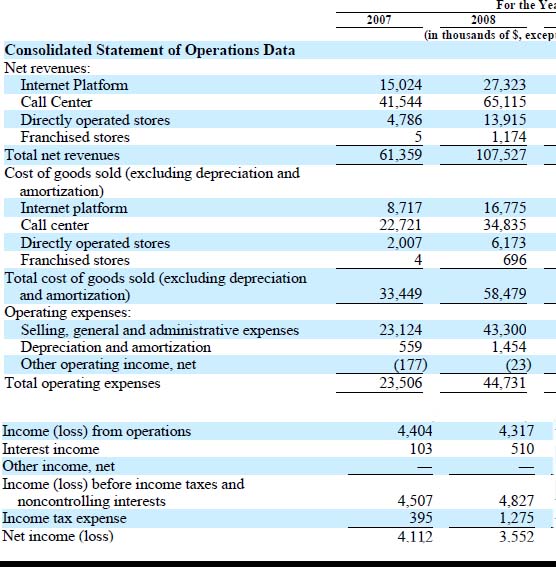
If the company succeeds in reducing expenses, and scales down the low-margin business segment, and scales up the higher margin business segment (the call center segment, which does most of its sales from Health Care and Beauty products, and currently attains close to 60% gross margin), I believe Mecox Lane can become profitable again. Look at the income statement for the year ended 2007-2008 which were the pre-Sequoia days. (See figure below) The revenue came mostly from call center. And the company had a net income around $3.5 million.

(click to enlarge)

Many investors have been abandoning ship lately, especially Chinese ships. However, at the current price, which is less than the total cash value per share, MCOX is not only a safe buy, but also a safe way to go to earn investors a nice return within just a few years. Just like Monnish Pabrai said, "Heads, I Win; Tails, I Don't Lose Much" But in this case, I might say "Heads, I Win Big; Tails, I Don't Lose At All."

Qihoo 360 Technology Now Covered by Analysts at Barclays Capital (QIHU)

Equities researchers at Barclays Capital assumed coverage on shares of Qihoo 360 Technology (NASDAQ: QIHU) in a report issued on Wednesday, Stock Ratings Network.com reports. The firm set an “overweight” rating on the stock.
The analysts wrote, “Following the release of its search engine (Aug 2012) and the announced partnership with Google (Jan 2013), Qihoo’s share price has re-rated. We expect further catalysts to come from: 1) a gradual ramp-up of its sales network through both expanded direct sales and the build-up of agency channels, leading to further growth in search revenue; 2) mobile Internet opportunities, via its rising penetration rate in mobile security and potential success of its app store strategy; and 3) non-GAAP margins expanding to the targeted normalised rate of 40%. We initiate coverage with an Overweight rating and US$38 PT, based on 20x 2014E non-GAAP EAPDS of US$1.88, which implies 0.26x PEG to a two-year (2013-15E) earnings CAGR of 77%. Top picks within our China Internet universe are Tencent, NetEase and Youku(all rated OW).”
Qihoo 360 Technology (NASDAQ: QIHU) opened at 30.44 on Wednesday. Qihoo 360 Technology has a 52-week low of $13.80 and a 52-week high of $30.89. The stock’s 50-day moving average is currently $30.20. The company has a market cap of $3.592 billion and a price-to-earnings ratio of 81.17.
A number of other analysts have also recently weighed in on QIHU. Analysts at Maxim Group reiterated a “buy” rating on shares of Qihoo 360 Technology in a research note to investors on Friday, March 15th. Separately, analysts at Zacks downgraded shares of Qihoo 360 Technology from an “outperform” rating to a “neutral” rating in a research note to investors on Monday, March 11th. They now have a $36.80 price target on the stock. Finally, analysts at JG Capital initiated coverage on shares of Qihoo 360 Technology in a research note to investors on Monday, March 11th. They set a “neutral” rating on the stock.
Four analysts have rated the stock with a hold rating and eight have given a buy rating to the stock. The stock has an average rating of “Buy” and a consensus target price of $37.20.
Qihoo 360 Technology Co Ltd (NASDAQ: QIHU), formerly Qihoo Technology Company Limited, is engaged in the operations of Internet services and sales of third party anti-virus software in the People’s Republic of China.

Tuesday, April 16, 2013

麦考林能否扭转巨额亏损?

如果麦考林能成功削减支出,同时裁撤低利润率的业务部门,有望再度实现盈利。

北京时间3月22日消息,美国投资资讯及分析网站Seeking Alpha周四刊载署名为Asia Stock Tracker(亚洲股票追踪者)的价值导向型个人投资者的分析文章称,麦考林(纳斯达克证券交易代码:MCOX)为投资者提供了一个极好的机会,能以超低价格买入一只注定将会带来可观回报的股票。
以下是这篇分析文章的全文:
麦考林是在美上市中国互联网公司中最大的失败者之一。与2010年每股55美元(经股票反向分割调整后)的IPO(首次公开招股)价格相比,麦考林股价已经下跌至今天的1.81美元。麦考林股价下跌的主要原因在于,这家公司在2011-2012年中蒙受了庞大的年度亏损,且美国市场投资者整体而言对中国公司的欺诈事件感到恐慌。
但有关麦考林的事实并未对欺诈指控形成支持。最近麦考林与Giosis组建的合资企业(49%股份由eBay持有,由Gmarket创始人负责运营)为其提供了一个回弹机会。而且,麦考林当前股价低于其资产负债表中的现金价值。
之所以会出现这种机会,是因为大多数机构投资者都已经清仓抛售麦考林股票,这种卖压导致其股价持续低迷。但我认为,看空人士对麦考林股票一直都反应过度。
公司背景
麦考林是在1996年成立的,自成立开始就由风险投资公司华平投资集团(Warburg Pincus)提供支持。在2008年,华平投资集团以8000万美元的价格将其所持全部麦考林股份出售给了另一家风险投资公司红杉资本(Sequoia Capital)。随后,麦考林于2010年10月份在纳斯达克IPO上市,IPO价格为每股美国存托凭证55美元(当时的IPO价格实际上是每股美国存托凭证11美元,但麦考林美国存托凭证与普通股的兑换比例已经从1:7变成1:35)。
麦考林旗下运营着趣天麦网(M18.com),这个网站主要出售服装和配饰,以女性互联网用户为目标客户。但麦考林还拥有其他销售渠道,其中包括一个呼叫中心和实体店等(既有直接运营店铺也有特许经营店铺)。麦考林来自于互联网销售业务的毛利率仅为20%,在这三种销售渠道中是最低的。在中国市场上,互联网销售渠道面临着激烈的竞争。因此,这家公司决定减少广告支出,其结果是2011年和2012年营收下滑。这就是麦考林决定退出这个平台,将趣天麦网交到Giosis手中的原因所在。
麦考林拥有两个自主品牌,分别是欧梦达(Euromoda)和Rampage,后者是通过授权方式从艾康尼斯(ICONIX)那里得来的。麦考林的实体店重点出售这两个自主品牌的产品。此外,麦考林还拥有医疗保健领域中的自主品牌(MaxiCare)和化妆品领域中的自主品牌(La Celler),这些产品通过其呼叫中心销售。这些品牌的销售业务给麦考林实体店和呼叫中心带来的毛利率高于互联网平台渠道的毛利率。
自2010年12月份IPO上市以来,麦考林的年度亏损总额已经超过了5500万美元(2011年亏损3300万美元,2012年亏损2240万美元),原因是中国电子商务市场上的竞争过于激烈。麦考林首席执行官在多次电话会议上表示,他正在削减被他认为是高到荒谬程度的广告费。削减广告支出之举为麦考林节省了资金,但同时也导致其营收下滑。此外,麦考林还通过裁员的方式削减了支出。但是,麦考林的支出仍旧未能足够迅速地下降,其结果是虽然运营成本下降,但公司仍旧蒙受了运营亏损。但在2011年以前,这家公司一直都具备盈利能力(参见以下麦考林向美国证券交易委员会(SEC)提交的20-F文件)。

麦考林20-F文件显示2011年前4年均实现盈利(腾讯科技配图)
主要股东
麦考林拥有非常出名的主要股东,其中包括新浪(纳斯达克证券交易代码:SINA)和红杉基金等,大多数主要股东所持麦考林股票的成本都高于今天的麦考林股价。举例来说,新浪在2011年以每股美国存托凭证30美元的价格从红杉手中收购了18%的麦考林股票。新浪在这项投资中投入了6600万美元的资金,按当前的麦考林股价计算这笔投资已经损失了90%左右。
在红杉支持下进行的中国公司IPO交易(如利农国际(纳斯达克证券交易代码:GAGA)和乡村基(纽约证券交易所交易代码:CCSC)等)中,大多数公司自IPO上市以来都遭遇了低估值水平的困境,但没有一家公司曾成为做空者的目标。红杉是美国市场上规模最大的风险投资公司之一。因此,红杉可能会急于让其支持下的公司IPO上市,这就迫使这些公司以无法持续的方式建设自身业务,如过度投入营销支出等。但这种激进的态度并不意味着欺诈。唯品会 是中国市场上的一个闪购网站,去年在纳斯达克IPO上市;与每股6.5美元的IPO价格相比,唯品会股价已经上涨了300%以上。唯品会的营收正在迅速增长,但仍旧面临着亏损。不过,对于中国公司停止在美国股票市场上市的趋势来说,唯品会的回归仍旧令人印象深刻。
我要藉此阐明的观点是,互联网公司是最容易在其中找到欺诈行为的例子之一。没人指责唯品会或百度(纳斯达克证券交易代码:BIDU)欺诈,所以投资者不会考虑欺诈的因素,而是以公允价格对这些公司进行估值。而与此相比,作为趣天麦网的运营商,麦考林是中国市场上领先的电子商务公司之一,理应在公开市场上获得更好的估值。但就现在看来,麦考林的股价低于资产负债表中的每股现金价值,这意味着投资者正在将其视为一家欺诈性的中国公司来进行估值。
与Gmarket创始人和eBay联手将趣天麦网重新上线
麦考林在最近宣布,与Giosis联手组建合资企业,将趣天麦网从一个电子商务网站变成一个在线购物平台,这也为这家公司投了“信任票”,并为其提供了一个回弹的机会。但如果想要让这件事情发生,首先需要给投资者一些时间,让他们知道Giosis是谁。
Giosis是Qoo10.com网站的所有者,后者是服务于亚洲主要国家的一个在线购物网站,由Young Bae Ku负责运营。Young Bae Ku是Gmarket.com网站的创始人,这是一家韩国互联网公司,曾是纳斯达克上市企业,后来在2009年以12亿美元的价格出售给了eBay。他随后又创立了Giosis,志在不仅使其成为韩国市场上的大型互联网公司,同时也在亚洲市场上站稳脚跟。为此,他举家搬到上海,寻求在中国市场上的发展机会。这也证明,他对于在中国市场上做生意的诚意深厚。Giosis的49%股权也归属于eBay。随后,他在2013年1月1日将趣天麦网重新上线(看看现在的趣天麦网吧,这个网站的页脚甚至有了eBay的Logo)。

趣天麦网的网站页面(腾讯科技配图)
麦考林与Giosis组建的合资公司Giosis Mecoxlane正在迅速发展,这家公司已经推出了新的iOS和Android版趣天麦网应用。我试用过iPhone版趣天麦网应用,用了大概一个星期。每隔几天时间,这个应用就会推出新的功能。在我最后一次使用时,这个应用还推出了幸运抽奖赠券,用户可以支付人民币1元抽奖一次,幸运者可赢得一台iPad mini。这个应用设计得不错,使用和导航都很方便。

趣天麦网的iPhone应用(腾讯科技配图)
麦考林之所以组建这家合资企业,是想要退出互联网平台,把重点放在自身的产品系列上。而与此同时,Giosis也想要一个像趣天麦网这样强大的品牌,以女性购物者为目标开展业务。趣天麦网将成为专门面向女性的在线购物网站,而不是像淘宝网或Qoo10.cn那样通用型的购物网站。
麦考林的新方向
麦考林已经投资大约4000万美元在吴江建设了一个新的运营中心,这个运营中心拥有每天处理10万个包裹的能力。麦考林首席执行官承认,这个运营中心的处理能力超出了公司的当前需求。但是,公司管理层还计划利用这种处理能力来提供第三方履约服务。作为一个在线购物平台,新上线的趣天麦网将可为这项计划提供推动力。
麦考林将通过多种互联网渠道出售自身产品系列,如天猫商城、唯品会网站、Qoo10.cn以及新上线的趣天麦网等。公司管理层预计,此举将为其节省广告支出。麦考林第一季度来自于互联网平台的营收预计将会下滑,原因是旧的趣天麦网还出售第三方产品,这种产品销售业务在其互联网渠道总销售额中所占比例为20%。但是,停止第三方销售业务将会提高麦考林来自于互联网销售业务的毛利率,而且还能释放一部分流动资金。
新的合资企业(Giosis-Mecox lane)将采用权益法作为会计核算方法(麦考林投资了500万美元,拥有新成立的合资企业的40%股权)。我预计,麦考林的销售、总务和行政支出将大幅下降,原因是该公司能通过削减其庞大的在线广告支出的方式来节省资金。此外,使用天猫商城和新上线后的趣天麦网服务的代理费将进入销售支出类别进行核算。这是一种比以前好得多的业务模式,原因是使用其他平台的代理费会依销售量的改变而发生变化。
强大的资产负债表和1000万美元的股票回购计划
麦考林在2012年5月份宣布了一项总额1000万美元的股票回购计划。自这项计划宣布至今已经过去了三个季度,但该公司仅花费了57.2万美元用来回购股票,这是由于美国证券交易委员会对股票回购设有限制。根据规定,麦考林不能回购数量超过30天日均成交量25%的股票。由于麦考林股票成交量很低的缘故,因此这家公司不能回购很多股票。但是,据麦考林提交的Form 20-F文件显示,截至2012年4月份为止,这家公司的在外流通美国存托凭证总量大约为400万股(美国存托凭证与普通股兑换比例为1:35)。因此如果按照当前股价(1.81美元)计算,那么麦考林仍可根据这项股票回购计划回购所有400万股在外流通美国存托凭证。
截至2012年12月底,麦考林持有的现金总额为1300万美元,短期投资总额为2060万美元,后者以结构化银行存款的形式存在,等同于现金。麦考林对新的合资企业投资的500万美元已经被计入预付费用类别。此外,麦考林没有任何银行负债,无论是短期还是长期。因此,麦考林的权益总额为8990万美元,而公司当前市值为2100万美元。这就意味着,麦考林的市净率(P/B,即每股股价与每股净资产的比率)仅为0.23倍,而2100万美元的市值甚至还不及麦考林所持有的现金总额。
首席执行官持有重大股份
麦考林首席执行官古永铿持有18,364,525股普通股,在麦考林股票总量中所占比例大约为5%。此外,他还持有3900万股期权,这就意味着他在麦考林的持股比例为12.9%左右。古永锵(微博)所持期权的行权价格为每股普通股0.16美元,相当于每股美国存托凭证5.6美元。新浪和中国动向集团(香港证券交易所交易代码:3818)等主要股东所持麦考林股票的成本价格为每股美国存托凭证30美元。红杉将所持麦考林部分股份出售给新浪和中国动向集团变现,但目前仍旧持有大约30%的麦考林股票。另一名管理层人员有权以每股5.6美元的价格买入麦考林的美国存托凭证。对公开市场投资者来说,有机会以远低于麦考林主要股东和内部人士的价格买入这家公司的股票,是件很幸运的事。私人投资者应可从这些行动以及当前资产负债表中看出,麦考林并非他们所担心的欺诈性的公司。
前景展望
如果麦考林能成功削减支出,同时裁撤低利润率的业务部门和扩大高利润率的业务部门(如呼叫中心业务部门,该部门大多数销售额来自于医疗保健和美容产品,当前的毛利率接近60%),那么我认为这家公司能再度实现盈利。不妨看看麦考林2007年和2008年的损益表吧,当时红杉还未收购华平投资集团所持麦考林的股份(参见下表)。可以看出,当时麦考林营收主要来自于呼叫中心,净利润为350万美元左右。

麦考林2007年和2008年的损益表(腾讯科技配图)
许多投资者最近都已经撤离股市,尤其是中国股票。但是,从麦考林当前低于每股总现金价值的股价来看,买入这只股票不仅是安全的投资,而且还肯定会让投资者在短短几年时间里获得可观的回报。正如对冲基金经理莫尼斯·帕波莱(Mohnish Pabrai)所说的那样:“人头,我赢了;字,没输多少。”但就投资麦考林而言,我要说的是:“人头,我大赢特赢;字,我毫发无损。”

T. Rowe Price Value Fund-TRVLX

U.S. News evaluated 333 Large Value Funds. Our list highlights the top-rated funds for long-term investors based on the ratings of leading fund industry researchers.

Performance

The fund has returned 20.13 percent over the past year, 13.03 percent over the past three years, 6.60 percent over the past five years, and 10.14 percent over the past decade.
Trailing Returns Updated 03.31.2013
Year to date 13.0%
1 Year 20.1%
3 Years (Annualized) 13.0%
5 Years (Annualized) 6.6%
10 Years (Annualized) 10.1%

Summary

T. Rowe Price Value has traditionally done a fine job of identifying underpriced companies.
As of April 03, 2013, the fund has assets totaling almost $14.56 billion invested in 113 different holdings. Its portfolio consists primarily of shares of large companies.
Like most value funds, this one looks for companies with strong fundamentals that nonetheless look cheap. Often, that means that management will seek out companies that are temporarily struggling. For instance, Bank of America, which finished last year in the red, and Pfizer, which broke even for the year, occupy prominent spots in the fund's portfolio. Lately, the fund's bets have been paying off. Notably, it finished in the top fifth of Morningstar's large value category in both 2009 and 2010. One of the bigger changes to affect this fund lately was the departure of manager John Linehan at the end of 2009. Linehan handed the fund off to current manager Mark Finn. Says Morningstar: "T. Rowe Price is known for smooth manager transitions, and the handoff at this fund reinforces that reputation." The fund has returned 20.13 percent over the past year and 13.03 percent over the past three years.
Historically, the fund has been a steady performer. While it has had very few banner years, its 10-year trailing returns still landed it, as of the end of the first quarter, in the top fifth of its Morningstar category. Over time, the fund's diversification has helped smooth out volatility. Management owns more than 100 names, which leaves plenty of room for the fund to absorb the impacts of the occasional dud. The fund has returned 6.60 percent over the past five years and 10.14 percent over the past decade.

Investment Strategy

The fund looks to own strong companies that are trading at a discount. Management will gauge value by considering a number of factors, including price-to-earnings ratios and the potential for future changes in the structure of particular companies. The fund is highly diversified and owns upwards of 100 names. Management also likes to keep a lid on the fund's turnover ratio, which currently sits at about 30 percent.

Role in Portfolio

Morningstar calls the fund a "core" holding.

Management

Mark Finn manages the fund.

Fees

T. Rowe Price Value Fund has an expense ratio of 0.85 percent.

Risk

Like all stock funds, this one comes with some risks.

Sequoia Capital

Sequoia was founded by Don Valentine in 1972 in Menlo Park, CA[1] and today has offices worldwide to support its international portfolio of companies.

Sequoia Capital is a venture capital firm specializing in incubation, seed stage, start-up stage, early stage, and growth stage investments in private companies. It also invests in public companies. The firm seeks to invest in all sectors with a focus on services including financial services, healthcare, Internet, outsourcing, retail, and wireless; mobile; technology; software including application, infrastructure, data management, and wireless; systems including networking, infrastructure, security, and wireless; components including semiconductors with a focus on analog and mixed signal, networking, multimedia, and programmable and wireless components; and energy including alternative energy, conventional energy, energy efficiency, energy storage, and energy services.

The firm seeks to invest in companies based in the United States for early and seed stage investments. However, for growth stage investments, it does not limit its investments to any country and recent funds have been internationally focused.[2] It invests between $100,000 and $1 million in seed stage, between $1 million and $10 million in early stage, and between $10 million and $100 million in growth stage. The firm prefers to invest in companies with an established revenue stream of $100,000 per month or greater.
 
Portfolio:
Sequoia invests in these sectors: Sequoia Capital's full portfolio can be seen on its website.
  • Financial services
Within financial services, it invests in banking, brokerage, payments, and enabling technology.
  • Healthcare
Within healthcare, the firm invests across diagnostic services, genetics services, lab services, patient services, product development services, and enabling technology companies.
  • Internet
Within Internet, it invests in advertising, communications, ecommerce, games, media, search, social networking, and enabling technology companies.
  • Mobile sector
Within the mobile sector, the firm invests in advertising, applications, devices and enabling technology companies.
  • Outsourcing
Within outsourcing, it invests across business process outsourcing, hosting services, managed services, professional services and software development services.
  • Technology
Within technology, the firm invests in semiconductor, sub-systems, systems, software, and services companies.
  • Other
It also invests in optical components; computer, subsystems, and communication systems; and consumer and professional services.

Investments:
The firm's investments include Airbnb, Apple, Aruba Networks, Google, YouTube, PayPal, Instagram, Cisco Systems, Oracle, Electronic Arts, Yahoo!, NVIDIA, Lattice Engines, Navigenics, Cotendo, Atari, Ameritox, Kayak, Meebo, Admob, Knowlarity Communications, Zappos, Green Dot and LinkedIn.[3] With its broad range of highly successful investments, Sequoia estimates that 19% of the NASDAQ’s value is made up of firms that they have invested in.[4]